

Which paints for painting ceramics really work?
Ceramic paints are not all created equal. When people first come to the workshop, they often have a question in their mind: "Can I do this at home with the paints I have?" The short answer is no.
Painting ceramics is not like painting a picture or decorating a wall. The piece has to go into the oven, and not all paints can withstand the heat. Knowing which paints to use for painting ceramics is the difference between a piece that lasts for years and one that will wear off in the first wash.
Why regular paints don't work for painting ceramics
Acrylic, canvas or craft paints may seem like a quick and cheap option. The problem is that none of them can withstand firing in a ceramic oven, which reaches 1,000°C or more.
Apart from the temperature, there is another problem: without firing, the paints do not really adhere to the surface of the ceramic. They remain on the piece like a film that, over time, water and detergents are responsible for eliminating. Result: a piece that loses its colors on the first wash in the dishwasher.
This does not mean that there are no options for painting ceramics without a kiln — they do exist, and we explain them below — but the result is never comparable to that of a properly fired piece.
Ceramic enamels: the paint that really works
The paint that is used professionally to paint ceramics is called ceramic enamel. They are mineral compounds — mainly metal oxides — that react with the heat of the oven and fuse with the surface of the piece, creating a shiny, hard and permanent finish.
Here are the main characteristics of ceramic enamels:
- Heat resistant: withstand temperatures of 1,000 °C or more without degrading
- Dishwasher safe: once cooked, the pieces can be washed normally
- Suitable for food use: baking eliminates any risk and makes the piece safe to eat and drink
- Durable: the colors do not fade or fade over the years
- They change with cooking: the color you see when you apply the nail polish is not the final color
This last point is important and often surprises people who come to the workshop for the first time.
Why do colors look dull while we paint?
One of the most common moments of bewilderment in the workshop is when people look at their half-painted piece and say: "But this looks brown, I wanted blue."«
Don't worry. Raw ceramic glazes — that is, unfired — don't show the final color. Many glazes appear gray, brown, or dull in the raw state, and are completely transformed during firing. A glaze that looks light brown may turn a brilliant cobalt blue. One that looks gray may turn a deep black.
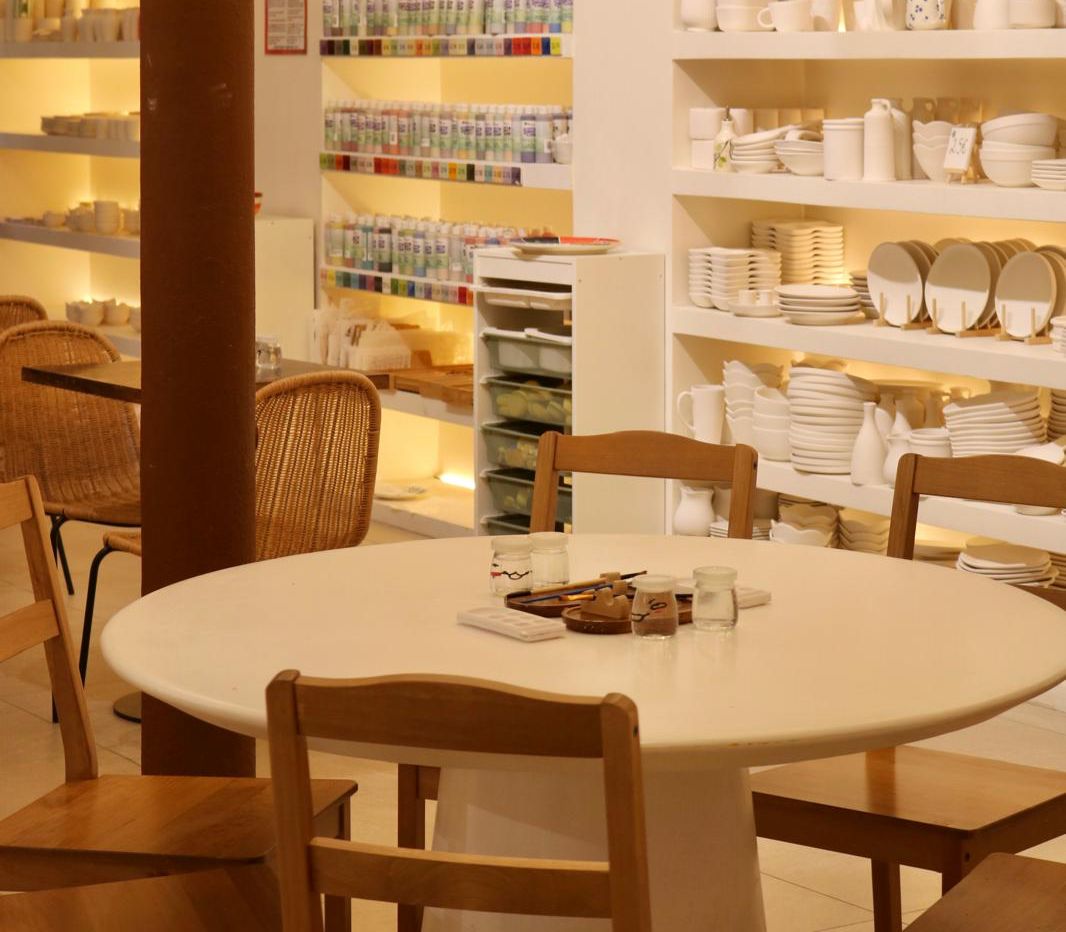
That's why in the La Pintoràmica workshop we have samples of all the colors already cooked. Before painting you can see exactly how each color will look, without surprises.
Types of paints and glazes for ceramics
Within the world of ceramic enamels there are several categories, each with specific properties and uses:
Stroke & Coat — the main paint
The Stroke & Coat that we use is an opaque and glossy glaze that covers the entire surface and gives solid and vivid colors. It works perfectly both in uniform layers and in more expressive and free brushstrokes. One of its great virtues is that the colors closely resemble the final result once fired — much more than is usual with other glazes — which makes it much easier to choose the color palette.
Ceramic pencils — for the details
For fine details — lines, text, small patterns, textures — we complement with ceramic pencils, which allow you to work with great precision. The beauty of the pencils is that the line remains below the final layer of transparent enamel, which completely protects it and makes it permanent. Perfect for writing names, dates or adding elements of detail that would be very difficult to achieve with a conventional brush.
The paints we use in the La Pintoràmica workshop
At La Pintoràmica's workshop we use exclusively Stroke & Coat, one of the reference ceramic paints in professional PYOP workshops. It is a high quality paint, easy to apply and gives very consistent results once fired.
Stroke & Coat has a thick, opaque texture that covers well in a single coat, making it ideal for those with no prior experience. Unlike other glazes, the colors closely resemble the final result once baked — much more so than usual — making it much easier to plan your design.
For fine details we complement with ceramic pencils, which allow you to draw precise lines, write text or add textures that would be impossible with a conventional brush. The line is fixed under the final transparent enamel and is completely permanent.
When you come to the workshop you have access to the full range of Stroke & Coat colors available, included in the price of the piece. There is no need to choose or pay separately — you take the ones you need for your design. The team helps you combine colors and guides you if you come with a specific reference.
Can I paint ceramics at home?
Yes, but with important limitations. If you want to reproduce at home the result obtained in a professional workshop, you need two things: professional ceramic glazes and a ceramic kiln.
You can buy glazes in specialized ceramic stores or online. The problem is the kiln: a professional ceramic kiln costs between €500 and €3,000, takes up space and requires a specific electrical connection.
There are alternatives for a home without an oven:
- Paints for unfired ceramics: they exist, but they don't give a finish as durable or dishwasher safe. They work for decorative pieces that won't be washed.
- Paints for cold porcelain: similar, with acceptable results for decoration but not for food use.
- Glazing with kitchen oven: It doesn't work. Domestic ovens don't reach the temperatures needed to melt ceramic enamel.
For most people, coming to a workshop like La Pintoràmica is the best option: you have all the materials included, professional enamel and oven, and you leave with a finished piece ready to use.
Frequently asked questions about ceramic paints
What paints are used to paint ceramics?
To paint ceramics, specific ceramic glazes are used that are fixed by firing in an oven at high temperature. Conventional acrylic paints or fabric paints are not suitable, because they cannot withstand the heat and will wear off with use.
Can you paint ceramics with acrylic paint?
Technically yes, but the result is not durable. Acrylic paints cannot withstand firing in a ceramic oven or daily use with water. If you want a piece that will last for years and is dishwasher safe, you need to use ceramic glazes and fire the piece in the oven.
Are ceramic paints toxic?
The professional ceramic paints used in workshops like La Pintoràmica are safe and suitable for food use once cooked. No special precautions are required during the painting session beyond not ingesting them directly.
Why do paints look dull when applied?
This is normal. Ceramic glazes change color a lot during firing. A color that appears dull brown can become an intense blue once fired. At La Pintoràmica's workshop we have samples of the fired colors so you can choose with confidence.
Can I buy the same paints to make ceramics at home?
You can buy ceramic glazes, but you will need a ceramic kiln to fire the pieces. Without a kiln, the paints will not set properly. That is why most people prefer to come to a workshop like La Pintoràmica, where everything is included.
Come paint ceramics at the Barcelona workshop
If you want to see how ceramic glazes work firsthand — and take home a piece painted by you, glazed and fired in the oven — come to the La Pintoràmica workshop in Gràcia or El Born.
You have all the colors included, the team helps you with the design and in 3 days the piece is yours.
Reserve your place here — limited places, especially on weekends.
If you want to delve deeper into the world of ceramic enamels, here you have more information about the Stroke & Coat.